A warehouse robot earns its place through repeatable work, not a polished demo.
The next group of warehouse robots will need to show four numbers that connect the machine to a real shift: useful work per hour, time between charges, recovery after a fault, and total cost per task.
Quick read
- Ask for the completed task rate, not the robot’s top speed.
- Check what happens after a blocked route, low battery, or failed pickup.
- Price the full system, including software, setup, service, and floor changes.
Work per hour
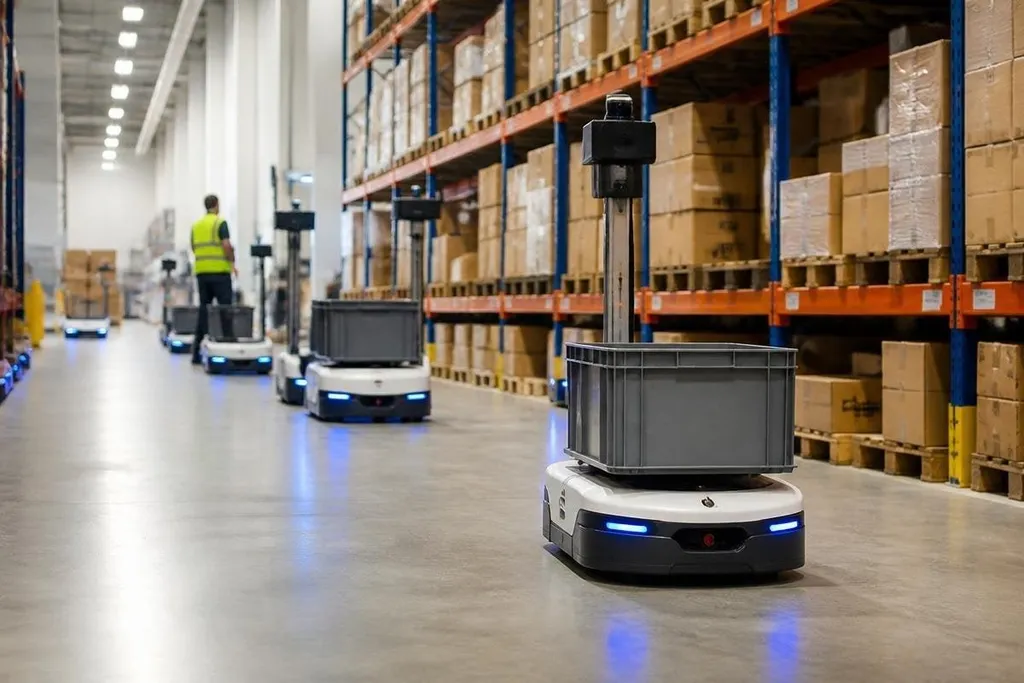
Speed matters only when the robot finishes the job. An autonomous mobile robot, or AMR, can move through a warehouse without fixed rails, but travel speed says little about its picking rate if it waits for a person, pauses at a shelf, or needs help after every missed item.
Ask for the number of completed tasks per hour under named conditions. The test should state the item size, payload, travel distance, number of stops, and share of tasks that need human help. Without those details, two figures cannot be compared fairly.
The same rule applies to robotic arms. A cycle time measured with an empty gripper may look useful until the arm must pick a soft package, check its grip, and place the item in a moving tote. The work unit is the full cycle, from pickup to a ready-for-the-next-task state.
Time between charges
A battery figure needs a work pattern beside it. A robot that runs for 8 h while carrying a light load on a clear floor may run for less time when it carries its rated payload, waits in traffic, and climbs a ramp.
Ask for four battery figures: charge time, work time at rated payload, battery swap time, and the charge level at which the robot stops work. Those numbers tell you how many robots a shift may need and where charging stations will sit.
Battery life also affects floor space. A robot that needs a long charge stop may require spare units, while a robot with a swappable battery may need storage, staff training, and a safe swap area. The hardware choice changes the layout around it.
Recovery after a fault
A blocked aisle is part of warehouse work. So is a tote placed a few centimeters outside its expected position. The useful question is how the robot returns to work after these events, and how often a person must intervene.
Manufacturers should report the rate of successful self-recovery and the average time to clear a fault. They should also show the full task, including the pause and restart. A video that cuts away before the handoff leaves the part you need to judge unseen.
A warehouse buyer needs the machine, task, site, and fault record behind any recovery claim. Robot24.com can connect those details to reports on warehouse robots and their tests. That record shows if recovery worked during a full task or only after a clean restart.
Safety affects recovery too. A robot that stops when a person enters its path protects the area, but each stop can reduce completed work. The useful measure is not a claim of safe operation; it is the number of stops, the reason for each stop, and the time needed to resume.
Cost per task
The purchase price is one line in the calculation. Add the robot, gripper or load carrier, charging gear, software fees, site setup, staff time, maintenance, and any change to racks or floor markings.
Then divide the total yearly cost by completed tasks. Use the same task definition across the current process and the proposed robot. A machine that costs less per unit but completes fewer usable tasks may not lower the warehouse bill.
The missing figure is often service cost. Ask who replaces worn wheels, sensors, batteries, and gripper parts, plus how long those parts take to arrive. A stopped robot still occupies floor space while the order queue keeps growing.
A buying check
Use this list before you approve a pilot:
- Name the task: write the start point, end point, payload, and handoff.
- Set the test window: run enough shifts to include normal traffic and blocked routes.
- Record human help: count each intervention and the minutes it adds.
- Price the full system: include hardware, software, setup, training, service, and floor work.
- Set a pass number: choose the completed-task rate and fault time that justify a wider rollout.
I'd wait for those figures before buying a robot described only through speed, battery size, or a short demo. The next useful warehouse robot will be the one that can publish its task rate, recovery time, and cost per completed job under conditions your team can repeat.